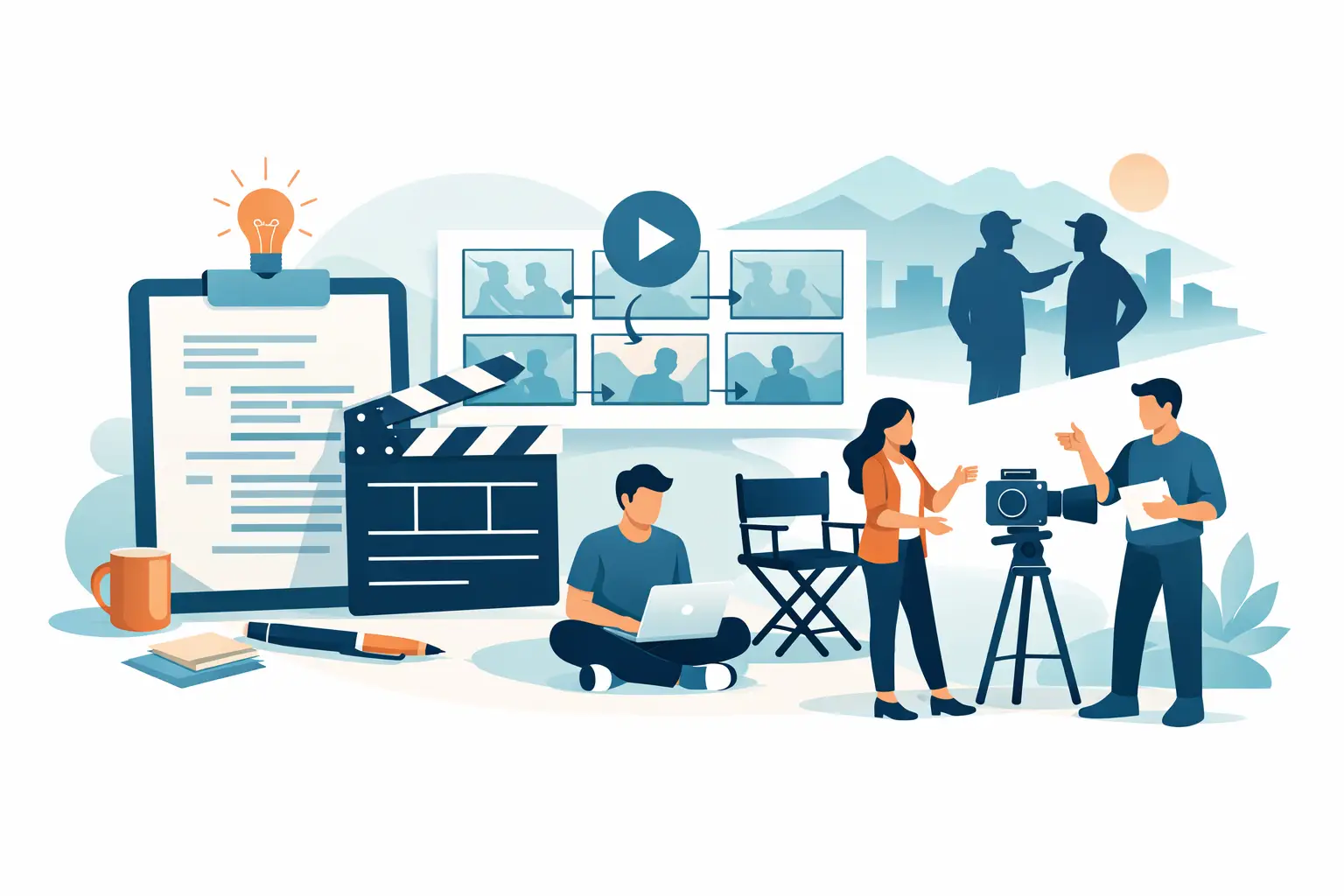
You finish the screenplay, export the PDF, and for a moment it feels like the hard part is done. Then the real gap appears. A script may be complete, but creative development from screenplay is what turns pages into a project other people can see, evaluate, fund, and build.
That gap is where many films lose momentum. Writers have a story. Producers need a package. Directors need a visual direction. Investors want clarity. Department heads need practical information they can act on. If those pieces arrive slowly or from five different vendors, development drags and early enthusiasm cools off fast.
What creative development from screenplay actually means
Creative development from screenplay is the process of translating a finished script into the materials that support decisions. That includes story analysis, visual references, character interpretation, tone exploration, audience positioning, early production planning, and pitch-ready assets.
The key point is that this is not just about making the script look polished. It is about making the project legible. A screenplay works as a reading experience, but film development depends on shared understanding across creative and business roles. The more clearly a script can be interpreted into visuals, strategy, and logistics, the faster a project can move.
A strong development process usually produces two kinds of value at the same time. First, it sharpens the creative identity of the film. Second, it reduces friction in pre-production. Those goals are connected. When tone, character, setting, and audience are defined early, planning becomes more accurate.
Why a screenplay alone is rarely enough
A screenplay is foundational, but it is still an intermediate format. It asks readers to imagine performance, framing, color, pacing, production scale, and market fit. Experienced producers can do that. So can strong directors. But even at a high level, interpretation varies.
That variance creates risk. One person reads a contained thriller. Another imagines a stylized elevated horror film. A third sees a modest indie drama with crossover festival potential. None of those readings may be entirely wrong, which is exactly the problem. If the project means something different to each stakeholder, decisions start drifting.
Creative development reduces that ambiguity. Character breakdowns clarify who the film is really about. Storyboards and shot concepts begin to define visual language. Audience insight helps test whether the premise is landing in the way the team expects. Budget estimates bring creative ambition into contact with production reality.
This is where trade-offs matter. The goal is not to over-determine every choice too early. Some projects benefit from leaving room for discovery. But lack of direction is not the same as flexibility. Good development gives a project a center of gravity without locking every detail in place.
The outputs that move a project forward
When filmmakers talk about development, they often mean notes, rewrites, and packaging. Those still matter. But modern creative development from screenplay is broader because the market is more visual, faster, and less patient.
A screenplay can now be turned into a working set of materials that help multiple conversations happen at once. Simulated audience responses can test tone and premise perception. Script analysis can identify structural pressure points, genre signals, and thematic emphasis. Character art and poster concepts give a project a recognizable surface. Storyboards and camera angle planning start translating dramatic intent into cinematic execution.
Some outputs are creative-facing. Others are operational. Budget forecasting, casting notices, and role breakdowns are not glamorous, but they are often what helps a screenplay become a producible plan. The real advantage comes when these outputs are connected rather than created in isolation. A visual concept should inform budget assumptions. Character interpretation should support casting language. Tone analysis should shape pitch materials.
Where traditional development slows down
The old workflow is familiar. The writer finishes a draft. A producer commissions coverage. A designer starts concept art. A line producer gives a rough budget. A storyboard artist may come in later. Marketing-style visuals show up later still. Every step depends on emails, scheduling, and reinterpretation.
That process can work, especially on projects with time and financing. But for indie filmmakers and lean production teams, it often creates delay at the exact stage when speed matters most. Momentum after script completion is valuable. If it takes weeks to assemble even a first pass of development materials, opportunities narrow. Meetings slip. Submissions stall. Team alignment weakens.
There is also a cost issue. Fragmented development means paying separately for tasks that overlap. One vendor analyzes the script. Another imagines the look. Another estimates scale. Because they work from different assumptions, the filmmaker ends up reconciling conflicting interpretations.
Fast, integrated development changes that equation. Instead of treating screenplay analysis, visualization, and pre-production planning as separate phases, it treats them as part of one translation process.
Creative development from screenplay in a faster workflow
A faster workflow does not mean a shallow one. It means compressing the handoff time between interpretation and action. If a finished screenplay can generate a package of development materials within roughly a day, the project gains immediate traction.
For filmmakers, that changes what happens next. You can refine a pitch while the script is still fresh. You can assess whether the project reads as premium, contained, commercial, or niche before spending weeks chasing the wrong packaging strategy. You can start conversations with collaborators using actual visual and strategic materials instead of abstract descriptions.
This is where a service like FilmPilot.ai fits naturally. Its value is not just speed for speed's sake. The point is receiving a connected set of creative and production-oriented outputs from a single screenplay upload, so the project becomes actionable quickly. That matters whether you are an indie producer trying to package a feature or a development executive sorting through multiple scripts under deadline.
What good development should reveal
The best development materials do more than decorate a script. They reveal what kind of movie is trying to emerge.
Sometimes that means confirming the obvious. A script that feels visually bold on the page may generate strong imagery and a clear poster concept. Sometimes it exposes a mismatch. A screenplay that reads expensive may actually depend on a compact set of locations and a small cast, making it more financeable than expected. In other cases, the process shows that the film's strongest hook is not the one the writer had been pitching.
That is useful because early clarity saves expensive confusion later. It can also shape revision choices. If audience insight suggests the midpoint loses urgency, or if character analysis shows the antagonist lacks definition, the writer and producer have something concrete to work from. Development becomes diagnostic, not just presentational.
Still, not every screenplay needs the same depth of treatment. A proof-of-concept short may need visual identity and audience framing more than detailed budget modeling. A feature heading into financing may need the opposite. The right creative development from screenplay depends on the project's stage, scale, and immediate objective.
How filmmakers should evaluate the process
If you are investing in development support, ask a simple question: does this package help more people say yes, faster?
That yes may come from a producer deciding the project is viable. It may come from a cinematographer responding to the visual direction. It may come from a financier understanding the scope. It may even come from the writer, who finally sees the film's tone reflected back with precision.
A useful development process should improve communication across roles. It should shorten the distance between screenplay completion and the next real decision. It should also respect the film's identity. Generic concepting is easy to spot. Materials only help when they feel specific to the script's genre, scale, and emotional core.
Speed is part of the value, but relevance is what makes speed matter. Fast output that misses the story creates more cleanup. Fast output that aligns creative intent with production planning can reshape the entire early phase of a project.
A completed script is not the end of development. It is the moment a project becomes ready to be translated. When creative development from screenplay is done well, that translation gives filmmakers something rare: momentum with direction. And in pre-production, that combination is often the difference between a script that sits and a film that starts moving.