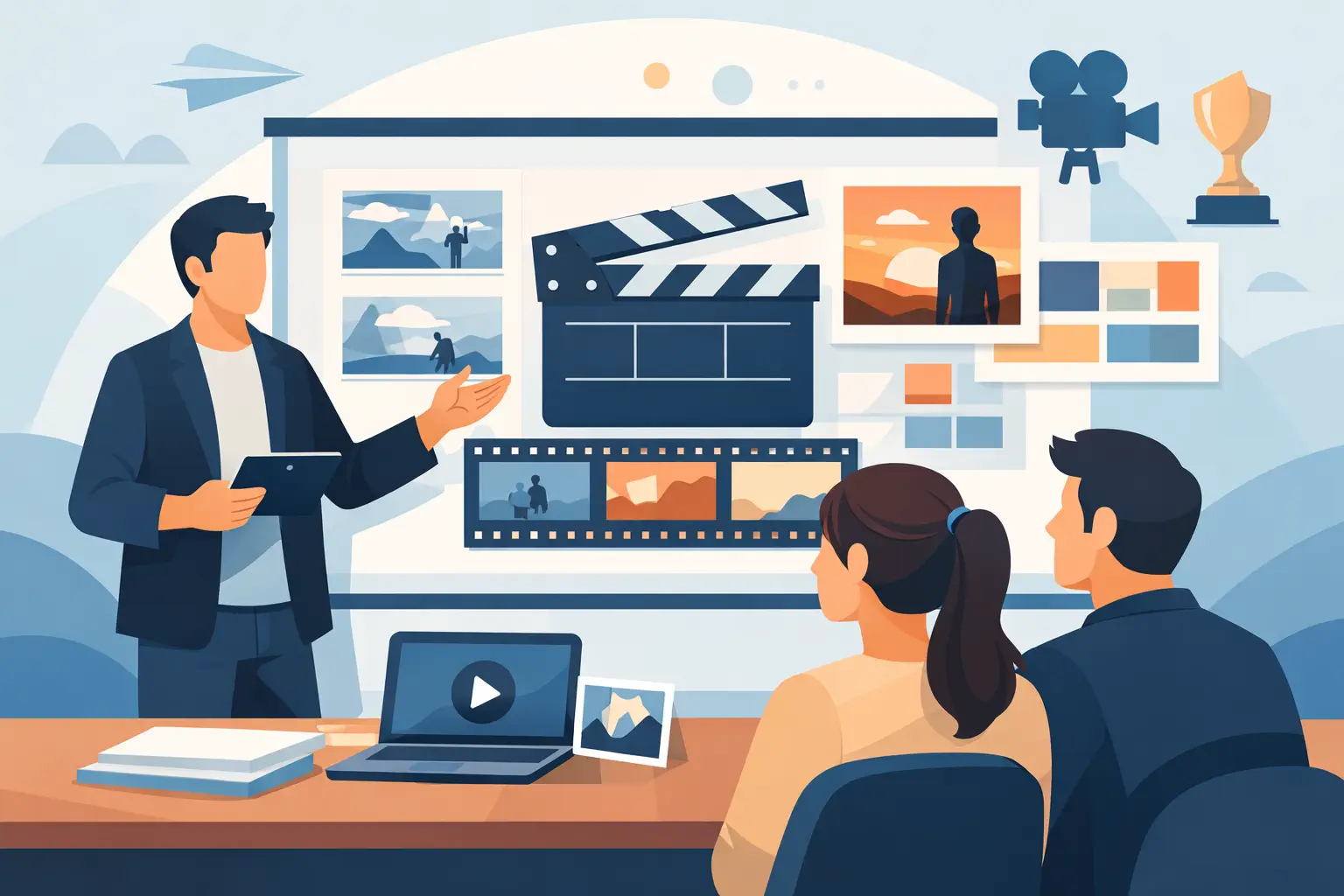
A verbal pitch can spark interest. Visual materials make that interest stick.
If you're figuring out how to pitch a movie with visual materials, the real job is not to overwhelm people with design. It is to remove guesswork. Producers, financiers, reps, and buyers need to understand your movie quickly - what it feels like, who it is for, how big it is, and whether the team can execute it. Strong visuals do that faster than a polished monologue ever will.
The mistake many filmmakers make is treating visuals like decoration. A mood board gets assembled late. A deck becomes a collage of reference images. Storyboards show up with no strategic purpose. None of that helps if the materials do not answer the decision-maker's core question: can I see the movie, the audience, and the path to production?
What visual materials are really supposed to do
A good pitch package reduces ambiguity. It gives the reader a controlled first impression of your project, rather than forcing them to invent one from scratch. That matters because every executive, producer, or investor is reading against a clock and against a slate of competing projects.
Visuals should clarify four things. First, tone - whether the film is grounded, heightened, prestige-driven, commercial, intimate, or stylized. Second, scope - whether this is contained, mid-budget, or logistically ambitious. Third, audience fit - who shows up for this film and why. Fourth, execution - whether the filmmaker understands the movie beyond the script page.
That does not mean every project needs the same package. A contained thriller may benefit from a tight lookbook and a few precise frames. A genre film may need concept art, world-building references, and sample storyboard sequences. A character drama may live or die on restraint, where too much visual packaging starts to feel compensatory. It depends on the project and on who is taking the meeting.
How to pitch a movie with visual materials without overbuilding
The strongest pitch materials are selective. They frame the movie rather than trying to pre-shoot it.
Start with the pitch deck or lookbook because it is usually the central sales document. It should communicate the hook, genre, tone, visual world, character identity, audience, and practical scale of the project. It also needs discipline. If every page has a different design language, or if the references feel pulled from unrelated films, your deck creates confusion instead of momentum.
From there, decide what additional materials actually strengthen the case. Storyboards help when there is a signature set piece, a complex action beat, or a strong visual grammar you want people to feel. Character designs help when the physical identity of the cast is central to the pitch. A teaser, pilot scene, or animated proof of concept can work when the concept is hard to explain in words or when tone is unusually specific. But if these materials look rough, inconsistent, or disconnected from the script, they can lower confidence instead of raising it.
The standard is not perfection. The standard is usefulness.
Build the visual package around decisions
Before you create anything, identify what decision you are trying to move. That changes the materials.
If you are pitching to a producer, the visual package should help them assess market position, packaging potential, and production feasibility. If you are pitching to talent, visuals should foreground tone, character identity, and the kind of film they would be stepping into. If you are pitching to financiers, the package should quietly reinforce control, audience targeting, and scale.
This is where many decks miss. They present attractive images but do not support a business or creative decision. A beautiful horror deck that cannot communicate whether the film is elevated festival material or commercial streaming fare leaves a buyer doing extra work. Extra work slows a yes.
The core materials that usually matter most
Most film pitches do not need everything. They need the right few assets presented with clarity.
The lookbook or pitch deck
This is the foundation. It should be visually cohesive and strategically lean. Open with the hook fast. Then establish the world, the emotional promise, the visual language, and the audience. If comps are included, they should be precise. Random prestige references do not impress anyone if they distort the actual movie you are making.
A strong deck also respects production reality. If your script is a contained indie, but your deck suggests a global tentpole, you create mistrust. Ambition is good. Mismatch is expensive.
Storyboards and shot concepts
These are most useful when the movie has defining visual sequences. One or two well-chosen scenes can prove directorial command far better than ten pages of generic imagery. They show rhythm, tension, geography, and intent.
For directors, this is often where credibility sharpens. For writers who are not directing, storyboard-style materials should still support the film's cinematic logic, but they should not pretend authorship that is not there.
Character and world visuals
Character boards, wardrobe direction, production design references, and location mood frames can be powerful if the movie's identity depends on them. They help people see casting possibilities and market positioning. They are especially useful in genre, historical, sci-fi, and stylized projects where the world itself is part of the sale.
Still, restraint matters. If every supporting role gets a page, the package starts to read like development sprawl.
Proof-of-concept media
A short teaser, tone reel, or first-pass pilot scene can create immediate traction. But this is the highest-risk material because it invites direct judgment. If the quality is weak, the project feels weaker. If the quality is strong, it can compress weeks of explanation into ninety seconds.
That trade-off is why speed and iteration matter. Tools that turn a finished script into storyboard concepts, character visuals, and planning assets quickly can help filmmakers test what actually improves the pitch before they overspend on custom materials.
Make the visuals feel like the movie, not the internet
Reference-heavy decks often fail because they borrow aesthetics without building a point of view. People can tell when images were collected because they look expensive, moody, or familiar. That kind of package may look polished, but it does not prove that the team understands this film.
The fix is simple. Every visual should answer a sentence you could say aloud in the room. This color language reflects the film's moral decay. These locations support a contained production model while preserving scope. This storyboard sequence demonstrates how suspense escalates without dialogue. If you cannot explain why an image is there, it probably should not be there.
Consistency matters more than volume. Five well-chosen pages beat twenty pages of mixed signals.
How to present visual materials in the room
Knowing how to pitch a movie with visual materials also means knowing when not to hide behind them. The visuals support the pitch. They do not replace your command of the story.
Walk people through the material with intention. Do not narrate every page. Use the deck to control pace and emphasis. Land the concept early, then let the visuals reinforce your confidence in tone, audience, and execution. If someone latches onto a frame, a character board, or a sequence, that is useful. It means the materials are doing their job.
Be ready for practical questions. Why this scale? Why this audience? Why now? Why this cast range? Visuals open the door, but clear answers close the gap between interest and next steps.
Common mistakes that weaken a visual pitch
The most common problem is excess. Too many pages, too many references, too much explanation. A pitch package should accelerate comprehension, not create a second reading assignment.
Another mistake is aesthetic inconsistency. If the deck says gritty realism but the artwork feels glossy and hyper-stylized, buyers notice the disconnect immediately. The same goes for mismatched comps, inflated production imagery, and borrowed references that misstate budget level.
There is also a timing issue. Many teams wait until a meeting is scheduled, then scramble to build materials in a rush. That usually leads to generic decks and uneven execution. Better visual packages come from treating development assets as working tools, not last-minute cosmetics.
That is one reason platforms like FilmPilot.ai are increasingly useful in early-stage development. Speed matters, but only if the output is actionable. When storyboards, character concepts, planning assets, and script-driven analysis arrive fast enough to shape the pitch itself, filmmakers gain leverage before the room, not after it.
A strong pitch creates alignment
The best visual pitch does not just make the movie look appealing. It makes the project easier to believe in. That is the difference between a deck people compliment and a package that moves conversations forward.
If your materials clarify the film's identity, show that you understand the audience, and prove that the project can be executed at the level you are promising, you are already ahead of most submissions. Make it easy for the other person to see the movie. Once they can see it, they can start wanting it.