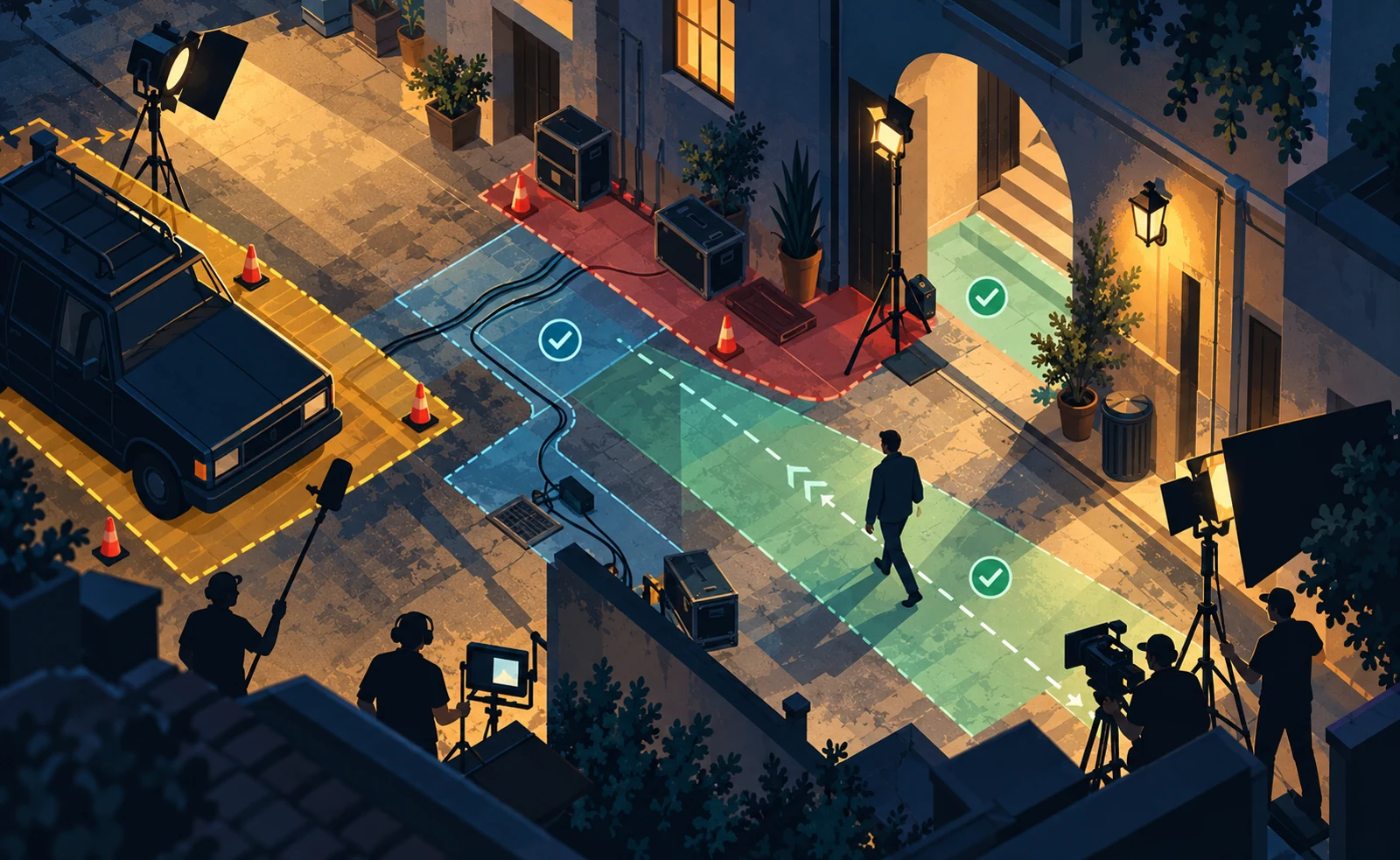
A film production risk assessment starts before the crew reaches the location. Read the screenplay alongside the proposed shoot plan, then ask what each scene requires people to do, where they will do it, and what could hurt them. A scene breakdown can reveal an exterior night shoot, a vehicle, a wet floor, or an animal. None of those labels is a safety decision on its own. They are prompts for the producer and qualified department leads to assess the actual activity and location.
This guide shows how to turn script and schedule notes into a working film production risk assessment, with a hypothetical scene example and a handoff that keeps safety decisions with the people responsible for them. It is a planning framework, not a substitute for a competent safety professional, local requirements, or a location-specific assessment.
Start with the script, but assess the real shoot
Make a first pass by scene number. Flag action involving vehicles, weapons, stunts, water, heights, animals, smoke, weather, minors, crowds, night work, or unusual equipment. Then add the production plan: location access, traffic, set construction, lighting and power, planned hours, crew size, and the shot approach. A scripted “rainy street” could mean an indoor set with a rain effect, a controlled exterior, or a public sidewalk. Those are different operations with different hazards.
FilmPilot.ai's Production Breakdown, VFX Breakdown, shooting schedule, and daily call sheets can help a team organize scene requirements and planning handoffs. They do not generate or approve a safety risk assessment. A producer should use the outputs as starting material, verify them against the locked script and actual plan, and involve the appropriate safety advisor and department specialists.
Build a scene-to-risk register
Give each flagged activity a row rather than writing “safety TBD” on a script page. A useful working register includes:
- Scene and version: scene number, script revision, planned shoot date and location.
- Activity and exposure: what performers or crew will actually do, who could be affected, and when.
- Hazard: the specific source of harm, not just a department label.
- Initial risk: a locally agreed assessment of likelihood and severity before controls.
- Controls and responsible lead: what will change, who owns it, and what evidence confirms it is ready.
- Residual risk and decision: reassess after controls; record who approves the plan or decides the activity must change.
- Change trigger: what would require a fresh review, such as a new location, action beat, effect, or weather condition.
Keep the register accessible to the production team and link it to the current schedule. The shooting schedule workflow helps identify where location changes and long days may alter the assessment; the schedule itself is not an authorization to proceed.
Worked example: a night exterior with a moving vehicle
Hypothetical scene: Scene 18 calls for an actor to cross a wet-looking alley as a car pulls up after dark. The director wants a low camera angle and reflections on the pavement. The producer is considering a real alley. This is an illustration, not a ready-to-use risk assessment.
- Separate creative intent from method. The story needs a tense arrival and reflective pavement. It does not necessarily require a moving car near the actor or a slippery walking surface.
- List the actual exposures. Vehicle movement near performers and crew, public access, uneven ground, cables and lighting, reduced visibility, water near electrical equipment, and fatigue from night work each need review. The location scout and qualified leads must inspect the real site.
- Choose safer methods before assigning controls. Could the vehicle be stationary when the actor crosses? Could framing and lighting suggest movement? Could reflective dressing replace standing water? The director, AD, transport, camera, electric, locations, and safety lead should agree on the method before the shot list is treated as final.
- Document ownership and a go/no-go check. Record who controls the vehicle and access, who verifies the walking path and electrical setup, who briefs the crew, and who can halt the activity if conditions differ from the plan. Do not use a generic checkbox to imply these checks happened.
- Reassess on change. A rain forecast, different alley, extra background actors, or revised blocking can invalidate the original assumptions. Update the assessment before proceeding.
The value of the register is the traceable decision: what changed between the screenplay and the safe shooting method, who reviewed it, and what still needs verification. A location scouting checklist can surface access, power, and public-foot-traffic questions, but a scout's notes alone cannot sign off on safety.
Know when the review must be more specific
Requirements vary by jurisdiction and production. For California productions participating in the Film and Television Tax Credit Program 4.0 safety pilot, Cal/OSHA's motion picture safety FAQ describes script- and production-plan-specific general assessments and additional specific assessments for activities including firearms, major stunts, major pyrotechnics, certain vehicle and watercraft work, and workweeks over 60 hours. The California Film Commission explains the pilot's tax-credit scope. Do not assume these particular pilot requirements apply to every indie film, or that productions outside the pilot have no safety obligations. Confirm applicable law and industry guidance with qualified local professionals.
Do not delegate specialized decisions about stunts, weapons, pyrotechnics, vehicles, rigging, water, or intimate or sensitive work to an AI-generated summary. Bring in the relevant qualified personnel early, and give them the script, intended method, location details, and schedule. If an activity cannot be planned and controlled appropriately, revise the method or do not shoot it.
Carry decisions into the daily plan
A risk assessment should not disappear into a folder after approval. Before each shoot day, compare the current script, location, weather, shot plan, and call sheet against the assessed version. Put practical briefing points and key contacts into the day's communication, while keeping the full assessment available to the team. FilmPilot.ai's call sheet guide explains the daily handoff; a call sheet safety note is a reminder, not the full mitigation plan.
Use a brief change log: what changed, who reviewed it, which controls changed, and whether work may proceed. That single habit prevents a carefully reviewed plan for one location or action from being silently reused for another.
Turn your screenplay into a better planning handoff
FilmPilot.ai can help you organize screenplay-derived breakdowns, shooting plans, VFX requirements, and daily call sheet inputs so qualified crew members have a clearer starting point for their own review. It does not replace a safety advisor or certify a shoot. Explore the FilmPilot.ai plans and pricing to choose the screenplay-to-pre-production package that fits your project, then put the resulting documents through a real department and safety review.