A film rehearsal schedule turns a screenplay into focused preparation for the people who will perform it. It answers a practical question: when should actors, the director, and key departments work through the scenes before the camera rolls?
For an indie production, rehearsal time is limited. A useful plan does not simply block out several afternoons and hope the right people show up. It groups scenes by cast, relationship, movement, complexity, and production risk so every session solves a specific problem.
The best starting point is the screenplay itself. When rehearsal planning is connected to script analysis, character breakdowns, locations, storyboards, and the shooting schedule, the team can prepare the scenes that need the most attention instead of treating every page alike. That is the broader pre-production workflow supported by FilmPilot.ai services.
What a film rehearsal schedule should accomplish
A rehearsal schedule should help the team:
- understand which actors are needed for each session
- prioritize scenes with difficult relationships, action, blocking, or emotional transitions
- protect actor availability and avoid unnecessary call-ins
- separate table work from movement and technical rehearsal
- surface script questions before they become shooting-day delays
- leave enough time for changes without turning rehearsal into an unplanned shoot day
Rehearsal is not a substitute for a shooting schedule. It is a preparation layer that makes the shooting schedule more realistic. For the production-day plan, see how to make a shooting schedule from a script.
Start with a scene and cast map
Read the script scene by scene and create a simple map with five fields:
- scene number and location
- characters present
- dramatic purpose or major conflict
- movement, props, stunts, or technical complications
- rehearsal priority
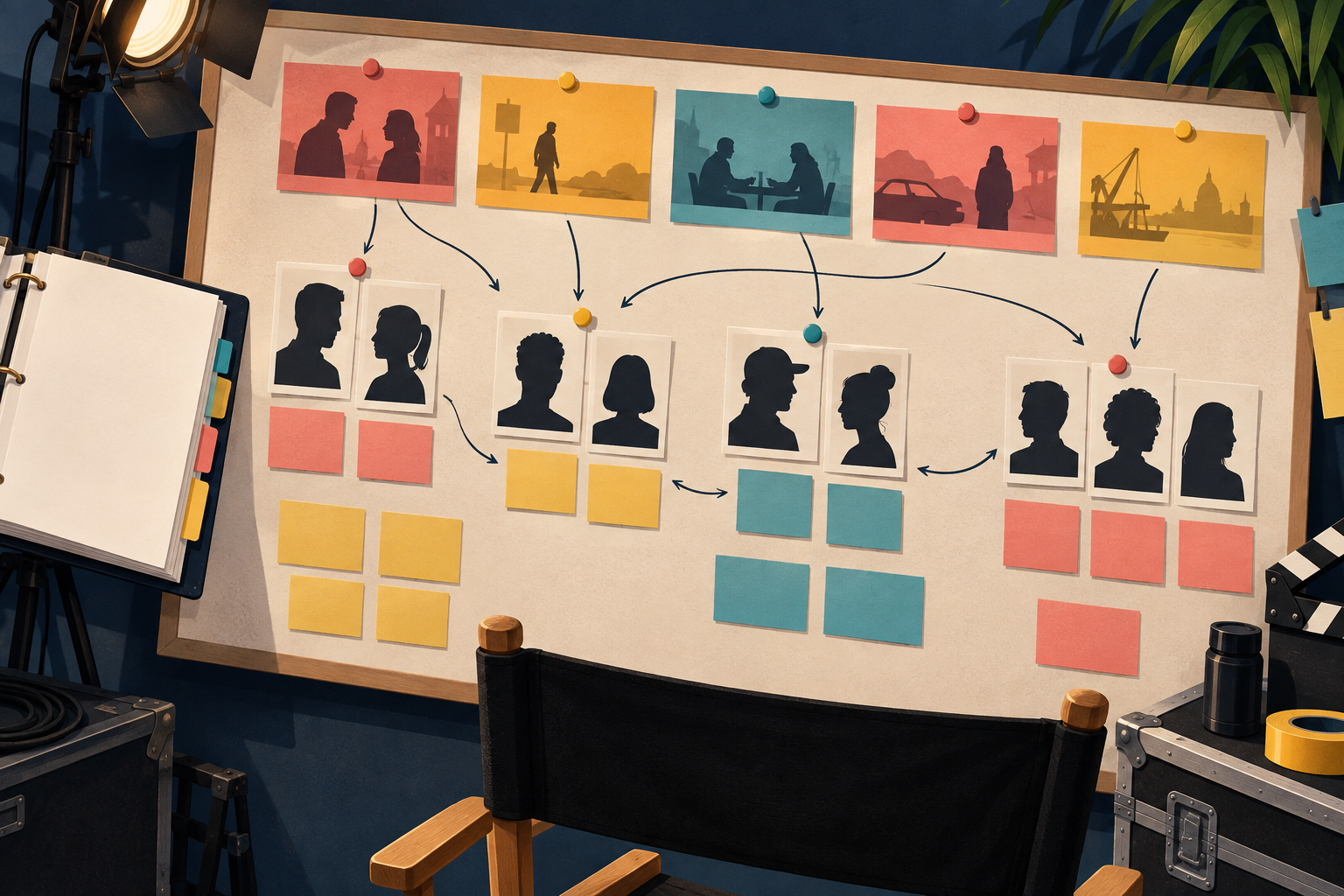
The cast list is the most important scheduling constraint. If a scene has two actors, it may fit into a short focused session. If it involves six actors with overlapping objectives, movement, and a reveal at the end, it needs more than a quick read-through.
Group scenes by the people who need to attend, not only by their order in the screenplay. This creates efficient rehearsal blocks for recurring pairings, family groups, ensemble scenes, and characters whose arc depends on a specific relationship.
How to make a film rehearsal schedule from a script
1. Mark scenes that need more than a table read
Start with a broad pass, then flag scenes where performance or coordination can materially change the result. These commonly include:
- first meetings and relationship turns
- arguments with complicated reversals
- intimate or emotionally exposed scenes
- ensemble scenes with overlapping dialogue
- physical business involving props, vehicles, or special movement
- action, stunts, weapons, minors, animals, or safety concerns
- scenes that must match a later or earlier emotional state
A scene can be short on the page and still deserve a high rehearsal priority. Page count is a poor proxy for performance difficulty.
2. Separate table work from blocking
Table work and blocking solve different problems. Table work is useful for objectives, subtext, relationships, tone, pronunciation, and questions about the text. Blocking is useful for entrances, exits, eyelines, movement, props, physical distance, and how the scene fits the camera.
Do not assume every scene needs both at the same intensity. A dialogue scene with a new cast pairing may need careful table work but simple blocking. A scene built around a doorway, a kitchen task, or a reveal may need more time on its feet than around the table.
3. Build rehearsal blocks around cast overlap
Use the scene and cast map to create blocks that minimize dead time. A practical block might cover:
- the lead and antagonist for their shared turning-point scenes
- the family group for table work and ensemble rhythm
- the action cast for movement and safety review
- the lead actor and director for a character-arc pass
Keep the attendance list visible. Calling in an actor who appears in only one short scene may waste scarce time and goodwill. On the other hand, excluding a supporting actor from a key relationship rehearsal can create continuity problems later.
4. Work backward from the shoot schedule
Rehearse important scenes before the production reaches them, but also consider the order in which the film will actually be shot. If the opening scene is scheduled for the final week, its rehearsal may still need to happen early because it establishes the tone and character baseline for the whole project.
Use the shooting plan to identify scenes with tight dependencies. The one line schedule can show where locations, cast, time of day, and company moves create pressure. Rehearsal should reduce that pressure, not add a separate layer of disconnected assumptions.
5. Reserve time for technical rehearsal
Not every technical question belongs in actor rehearsal, but some do. Reserve targeted time for scenes involving:
- complex entrances, exits, or crossovers
- props that affect the performance
- camera movement or precise eyelines
- fight choreography or safety procedures
- costume restrictions or unusual physical behavior
- sound-sensitive movement or overlapping dialogue
The goal is not to lock every creative choice too early. It is to identify the choices that could cause a reset, missed cue, unsafe movement, or unusable coverage on the day.
6. Add a revision and handoff buffer
Leave room between the final rehearsal pass and the first shoot day for meaningful changes. Actors may discover that a line does not land, the director may simplify blocking, or a location may force a different entrance. A schedule with no buffer treats the first production day as the only place to discover those issues.
After each session, record decisions and open questions in a shared note. Those notes should flow into the script supervisor's continuity plan, the shot plan, and the relevant call sheet. A script supervisor checklist is a useful companion for tracking changes that must remain consistent.
A simple film rehearsal schedule template
For each rehearsal block, include:
- date and start/end time
- location or video link
- actors and departments required
- scene numbers and pages
- session type: table work, blocking, movement, or technical
- priority question or objective
- props, wardrobe, or reference materials needed
- decisions and follow-up owner
Here is a compact example:
- 9:00–10:00: Lead and antagonist, scenes 12 and 28, objectives and reversals
- 10:15–11:30: Family ensemble, scenes 7 and 19, overlapping dialogue and entrances
- 11:45–12:30: Director and lead, character arc and opening baseline
- 1:30–3:00: Action group, scene 34, movement, prop handling, and safety
- 3:15–4:00: Full group, scene 41, blocking and camera-dependent eyelines
Common rehearsal scheduling mistakes
Scheduling by availability alone
Availability matters, but a calendar full of convenient sessions can still fail if the high-risk scenes are not prioritized. Start with the script's performance and production demands, then fit them into realistic availability.
Rehearsing every scene in screenplay order
Screenplay order is useful for reading the story, not always for using rehearsal time efficiently. Cast overlap, relationship arcs, location constraints, and technical risk are usually better grouping signals.
Ignoring the physical world of the scene
A table read cannot answer every question about a scene built around a narrow hallway, a specific prop, a vehicle, or a timed movement. Flag those scenes early and rehearse the physical problem at the right level.
Failing to record changes
A rehearsal note that never reaches the script supervisor, AD, camera team, or call-sheet workflow becomes version drift. Record what changed, what remains open, and which document must be updated.
Where FilmPilot.ai fits
FilmPilot.ai can help turn a screenplay PDF into the planning information needed to build a rehearsal schedule: character relationships, scene structure, production elements, visual planning, locations, budgets, and shooting schedules. The value is not an automated calendar pretending to replace a director or producer. It is a faster first pass that gives the team a shared map before rehearsal begins.
That connected view matters because rehearsal decisions affect more than performances. They can expose a scene that needs rewriting, reveal a location constraint, change a blocking idea, or alter the amount of time a production day needs. Starting from the same screenplay source keeps those decisions easier to carry into the rest of pre-production.
Make rehearsal solve the right problem
A good film rehearsal schedule does not try to rehearse everything equally. It puts the right people in the room for the scenes where preparation can improve performance, safety, continuity, or production efficiency. Start with the script, group by cast and complexity, connect the plan to the shoot schedule, and document the decisions that affect other departments.
When you are ready to turn a screenplay into a broader pre-production package, review FilmPilot.ai pricing and choose the workflow that fits your project.