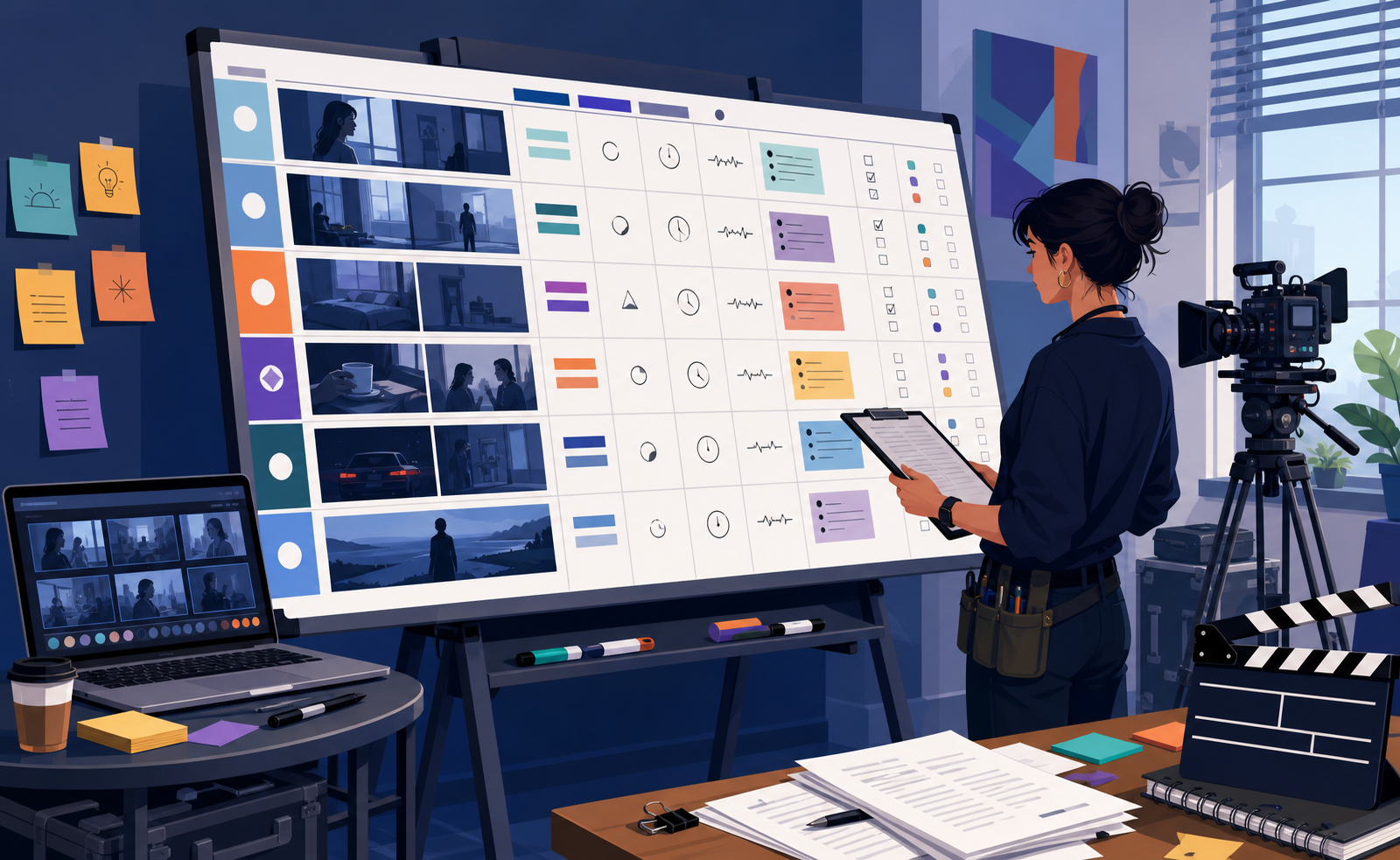
A script supervisor can save an indie film from expensive continuity mistakes, missing inserts, coverage gaps, and editorial confusion. If you are building a script supervisor checklist for an indie film, the goal is not paperwork for its own sake. The goal is to protect the story, the schedule, and the edit while the set is moving fast.
On small productions, continuity problems rarely look dramatic in the moment. They show up later when wardrobe changes between takes, props jump positions, eyelines drift, scene timings stop matching, or the edit reveals that one missing detail breaks the sequence. A practical checklist keeps those errors visible before they become reshoots.
That is one reason script supervision works best when it is connected to the rest of pre-production. When your breakdown, schedule, location plan, and daily paperwork come from the same script, the supervisor is not guessing what matters most. FilmPilot.ai is built for that connected workflow through its pre-production services, including production breakdowns, shoot schedules, call sheets, storyboards, and screenplay analysis.
What a script supervisor checklist should actually cover
A useful checklist should help you track four things at once:
- story continuity across shots and scenes
- production facts that editorial will need later
- schedule changes that affect coverage or timing
- small visual details that can quietly break a cut
That means the checklist is bigger than props and wardrobe. It should also capture actor movement, line changes, slate and take notes, camera direction, scene timings, and any deviation from the script that matters downstream.
Why indie productions need a tighter continuity checklist
Large productions may have more department support and more margin for pickups. Indie films usually do not. If continuity drifts on a compressed schedule, you may not discover the problem until the location is gone, the cast is unavailable, or the budget cannot absorb another day.
That pressure is why script supervision should be treated as a cost-control tool, not only a creative support role. The same planning logic shows up in shoot scheduling and one line scheduling. When the production plan is clear early, the continuity checklist becomes sharper because the team already knows what needs to stay consistent.
Pre-shoot script supervisor checklist
Before cameras roll, the checklist should start with the screenplay and the schedule, not the set.
1. Break down each scene for continuity-sensitive elements
- wardrobe changes and costume wear state
- props handled, consumed, moved, or destroyed
- hair, makeup, blood, dirt, sweat, and weather exposure
- character entrances, exits, and screen direction
- time-of-day logic and story chronology
- special actions like smoking, eating, driving, sitting, standing, or handing off objects
This is where screenplay intelligence can help. FilmPilot.ai can turn a screenplay PDF into structured production outputs that make continuity planning easier before the first setup is built.
2. Review the shooting schedule for risk points
Continuity gets harder when scenes are shot out of order, split across days, or grouped by location despite happening at different points in the story. Mark scenes that are likely to cause confusion because of:
- multiple wardrobe states in one location block
- props that appear partially used or damaged
- day-to-night or night-to-day story transitions
- repeated emotional beats filmed weeks apart
- child actors, animals, stunt beats, or practical effects
If the schedule is still soft, fix that upstream. A continuity checklist cannot fully protect a weak schedule. That is why it helps to pair this work with solid call sheet planning and reliable scene order.
3. Prepare scene-by-scene tracking pages
For each scene, leave room to log:
- slate and take numbers
- circle takes or preferred takes
- line changes and improvisations
- camera setup notes
- timings for script and actual takes
- continuity notes for props, body position, and eyelines
On-set script supervisor checklist
Track actor and object continuity
Watch for repeated actions that must match from angle to angle. Which hand picks up the glass? When does the actor sit? How many bites are left? Which direction does the character look before the cut? These details seem small until editorial tries to intercut coverage.
- hand usage and physical gestures
- seated versus standing positions
- prop placement before and after action
- costume condition and accessory placement
- screen direction, eyelines, and crossing movement
Track what changed from the page
The script is not always what gets shot. The director may cut dialogue, actors may paraphrase, blocking may shift, and a location may force a visual rewrite. Note those changes clearly. Editorial, pickup planning, and later scene work depend on knowing what the final version became on set.
Track editorial facts, not just visual facts
A good script supervisor log also records what the editor will need later:
- which takes were strongest
- whether a line was fully covered
- whether overlaps, interruptions, or off-camera cues changed
- whether the setup protects a clean entrance, exit, or reaction beat
- whether inserts or cutaways are still missing
Mark schedule-driven risks before moving on
Before the company leaves a setup or location, confirm that the scene is truly covered. On indie shoots, missing one insert, one reaction, or one continuity correction can cost far more than spending five extra minutes checking the board.
Simple script supervisor checklist template
Here is a practical checklist structure you can adapt for each scene:
- Scene number and story day
- Location
- Interior or exterior
- Day or night
- Wardrobe state
- Hair and makeup notes
- Props in scene
- Character entrances and exits
- Blocking notes
- Eyeline and screen direction notes
- Slate and take log
- Line changes or ad-libs
- Circle take or editor preference
- Missing insert or pickup notes
- Continuity warnings before wrap
If your production is moving fast, this kind of structure matters more than perfect formatting. The point is to catch repeatable details while there is still time to adjust.
Common continuity mistakes the checklist should catch
Prop resets that drift
Drinks rise or disappear, bags change shoulders, phones move pockets, and papers shift positions. These are classic edit problems because they are easy to miss during a busy setup.
Wardrobe progression errors
If scenes from different story moments are shot back to back, the clothing state can easily collapse unless it is tracked clearly.
Unlogged line changes
A rewritten line may improve the scene but create an edit issue if matching coverage still uses the original phrasing.
Coverage gaps that only show up later
Sometimes continuity is technically fine, but the scene is missing a connective insert, reaction, or transitional beat. A strong checklist should remind the team to confirm coverage completeness, not only visual consistency.
Where FilmPilot.ai fits in this workflow
FilmPilot.ai is useful because script supervision gets easier when the screenplay has already been translated into production-ready structure. The platform can help teams move from script PDF to breakdowns, scheduling logic, location support, storyboards, and daily production documents from one source. That means fewer disconnected notes and fewer continuity surprises caused by conflicting prep materials.
It also maps cleanly to the live service lineup. FilmPilot.ai offers screenplay analysis, production breakdowns, production shoot schedules, storyboards, camera shots and angles, automated location scouting, and daily call sheets through its service stack. Those outputs give script supervisors and producers a stronger continuity foundation before the first day of photography.
Use the checklist to protect the edit, not just the set
The best script supervisor checklist is not just a way to stay organized during production. It is a way to protect what happens after production. If the editor can trust the notes, the takes, and the continuity logic, the film moves faster and cleaner through post.
That matters even more for indie teams working without much pickup margin. A disciplined checklist is cheaper than a fix.
Ready to turn your script into a more production-ready plan?
If you want help turning a screenplay into breakdowns, schedules, call sheets, visual planning assets, and a stronger pre-production package before you hit the set, FilmPilot.ai can help.